Declaration of safety labels
SOLAS
The International Convention for the Safety of Life at Sea (SOLAS Convention) is the main international convention for safety at sea and was established in 1914 after the Titanic disaster in 1912. SOLAS has been under the International Maritime Organisation (IMO) since 1954.
SOLAS describes what requirements seagoing vessels must meet in terms of construction, equipment and crew, depending on the area of operation. Equipment includes radio equipment and safety equipment, such as lifeboats, rafts and fire-fighting equipment. Supervision of SOLAS compliance lies with the flag state, although this is increasingly outsourced to classification societies.
MED 96/98/EC
The Marine Equipment Directive 96/98/EC (MED 96/98/EC) are the requirements set by the International Maritime Organisation (IMO) for commercial shipping. These requirements apply to all new ships and to all existing ships not yet equipped with approved equipment.
MED 96/98/EC applies to the following items of marine equipment:
· Life-saving equipment;
· Marine pollution prevention;
· Fire protection;
· Navigation equipment;
· Radio communication equipment.
MED 96/98/EC covers EU requirements for transport and international maritime conventions (IMO, SOLAS) and international standards (IEC, ISO). Equipment that has been approved bears the mark of conformity, a steering wheel.
ES-TRIN
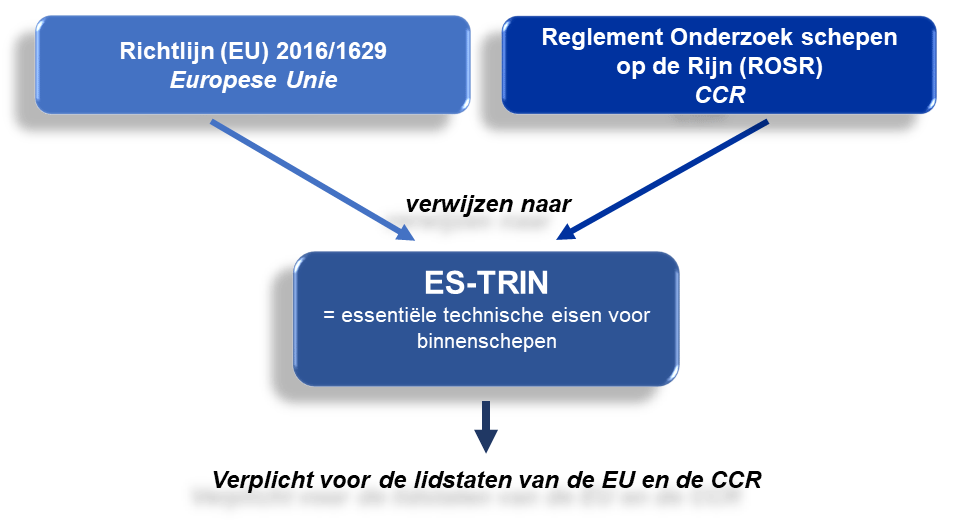
ES-TRIN (European Standard laying down Technical Requirements for Inland Navigation vessels) is a term commonly used in the inland navigation industry for the standard containing the technical requirements necessary for the safety of inland vessels operating on European inland waterways. It aims for uniform, modern and user-friendly regulations.
It is a document of CESNI, which stands for the European Committee for Standardisation in Inland Navigation.
The standard establishes the necessary uniform technical regulations to ensure the safety of inland vessels. The standard contains provisions relating to the construction, fittings and equipment of inland vessels, special provisions for specific categories of vessels such as passenger vessels, pushers and container ships, provisions relating to vessel identification and model certificates and the model register, transitional provisions and instructions for the application of the standard, along with new regulations on the use of liquefied natural gas (LNG) as fuel.
ES-TRIN is not binding in itself.
As long as the application of this standard is not yet enshrined in European national legislation, the Rhine Vessels Inspection Regulations (ROSR) and on other navigable inland waterways the harmonised regulations of Directive 2006/87/EC remain in force.
The standard has been prepared not only in Dutch, but also in German, English and French.
In the Dutch version, the document contains 502 pages, including annexes.
ATEX
The term ATEX covers all situations where there is a risk of gas and dust explosion hazards. The abbreviation ATEX comes from the French words ATmosphere EXplosible from the European explosion safety directives. Companies and organisations working in explosive environments must take measures so that employees can carry out their work safely. ATEX standards or directives have been drawn up for this purpose. One of these standards consists of training and educating employees in working safely within a hazardous area by means of an ATEX training course.
ATEX NORM
Two ATEX directives have been drawn up within the European Union. Each member within the EU must incorporate these directives into its national legislation. In the Netherlands these directives are included in the Commodities Act and the Working Conditions Act.
ATEX 114
ATEX Directive 114 (2014/34/EU and formerly ATEX 95) stipulates which standards equipment and products must comply with that are used in explosive environments. This directive mainly applies to manufacturers.
Products that meet the requirements of the ATEX 114 directive can be recognised by an additional sign in combination with the CE marking